
How to get seen, get clicks, and get customers… fast
In my time working with local service businesses- a mechanical company, a wellness clinic, an automotive appraiser, and more, I have noticed one common thread: every single click counts. These customers are not leisurely browsing with a latte in hand. They are frantically Googling because something is broken, leaking, crawling, or flat-out not working. And let’s be real, if your business is not the first thing they see, they ARE calling your competitor.
That is why I am a firm believer in smart, strategic paid advertising (especially on Google Ads) for local service providers. When done right, I’ve seen even small businesses dramatically boost their bookings and revenue. Paid ads can deliver qualified leads without wasting budget on “just curious” clicks.
Here’s how to build a paid ad strategy tailored specifically for local service businesses:
Start with Search Intent: What Are They Really Looking For?
At the heart of every effective campaign is understanding why someone is searching (a concept often referred to as search intent or keyword intent). For local service businesses, this understanding is not just helpful… it.is.everything.
Most local service customers are not looking for the history of your organization or a long story about how your business got started. They are searching
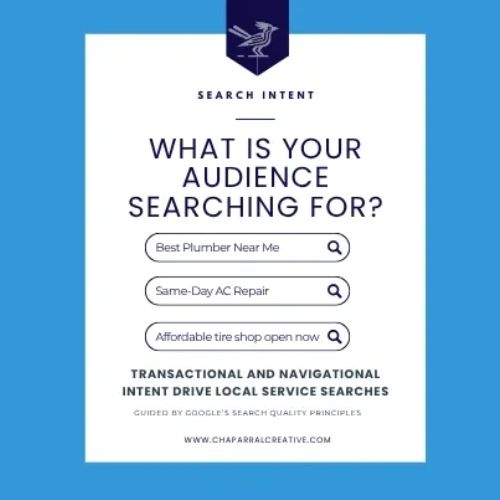
because something is broken, urgent, or inconvenient, and they need a fast, trustworthy solution. These are action-driven, high-intent users. Think:
- “Closest place to get an oil change”
- “Best plumber near me”
- “Same-day pest control”
These are examples of transactional and navigational search intent. Users are either ready to act (call, book, or buy), or they are trying to quickly identify and compare local providers. According to Google’s Search Quality Evaluator Guidelines, understanding the user’s intent is fundamental:
“Search engines exist to help people find what they are looking for. To do that, they need to understand what people are looking for—the intent behind the query—and provide results that are helpful and trustworthy.”
There are companies who waste their budget on terms like “professional tips” or “the history of eggplant.” Once they shifted to service and urgency-based searches, the cost per lead dropped by almost 60%. Moral of this story: target action, not curiosity.
Geo-Target Like You Mean It
For local businesses, local is everything. Research shows that tight geographic targeting is often the difference between profitable campaigns and money pits.
Google Ads lets you target by:
- Zip code (great for upscale neighborhoods or commercial districts)
- City or town (when you serve specific municipalities)
- Radius targeting (e.g., “15 miles from my shop”)
If you serve multiple areas, tailor your ad groups. “AC Repair in Fort Worth” should have different copy than “AC Repair in Weatherford.” This not only improves relevance but boosts your Quality Score, lowering your cost per click. Don’t waste money showing ads to customers you can’t (or don’t want to) serve.
Localize Your Copy (Your Customers Can Tell)
If your copy doesn’t feel local, it doesn’t feel trustworthy. I recently saw an ad that clearly did not“get” small-town Graham, America and it stuck out… but in all the wrong ways.
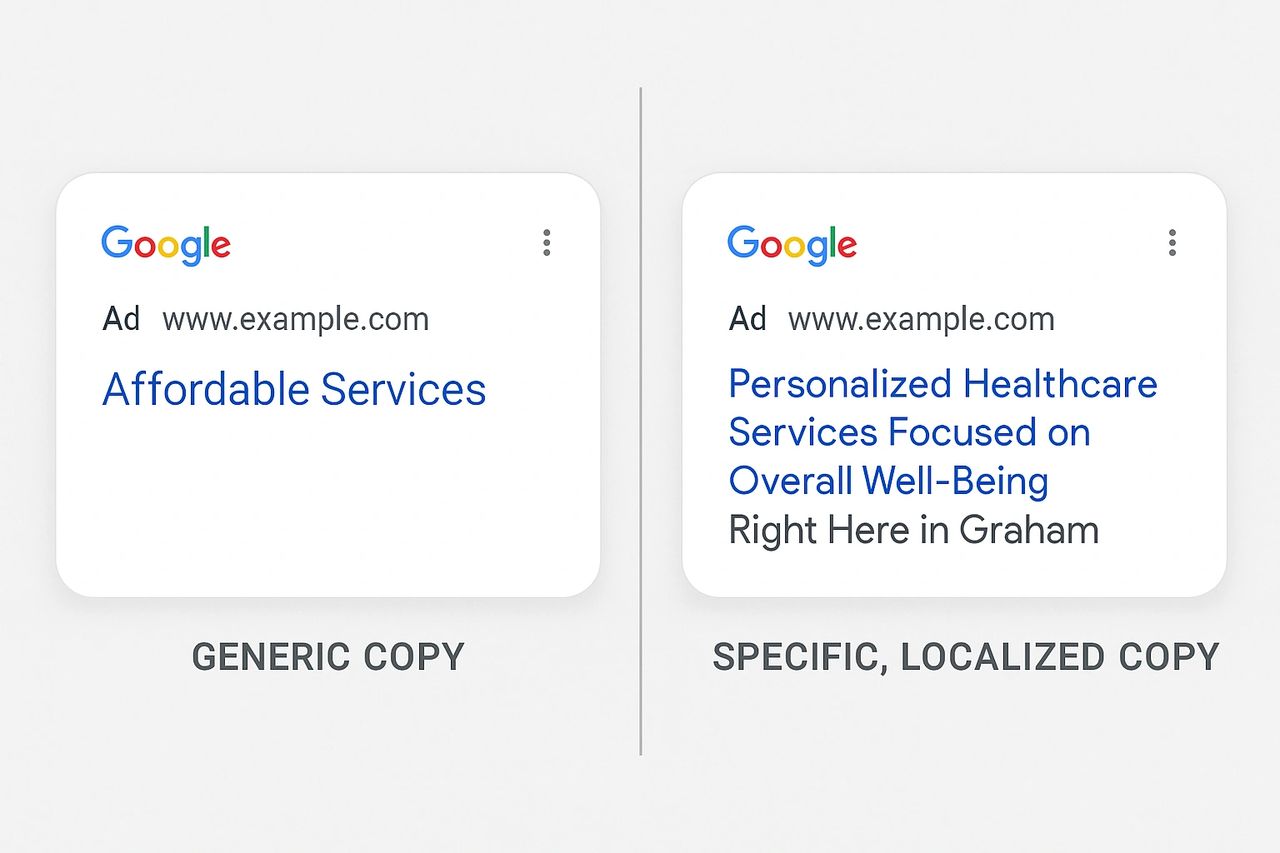
Instead of boring, generic, copy like “Affordable Service,” try:
“Family-owned HVAC company serving Fort Worth since 1997”
“Personalized wellness care, right here in Graham”
Localized messaging increases consumer trust by up to 4x, according to Locality. Use ad extensions to amplify your visibility:
Location extensions – show your business on Google Maps
Call extensions – enable click-to-call (a must on mobile)
Review extensions – show off your great reputation
Callouts – highlight differentiators like “Emergency Response” or “Veteran-Owned”
Recap: Generic service ads get ignored. Be authentic. Tell customers, and show customers, that you are genuinely part of the community.
Build Landing Pages That Actually Convert
This is where I see so many local businesses fumble. They spend good money on great ads… then send everyone to their homepage. Big mistake.
This is like going to a restaurant and the server asking if you would like the daily special. When you say “yes” the server hands you a menu and asks you to find it on the menu to read the exact description of the dish aloud prior to being able to order the meal. This type of disconnect will kill a conversion rate.
Your landing page should:
Match the ad language exactly
Have one clear call to action (call now, book online, etc.)
Include trust signals: testimonials, licenses, BBB logo
Use a local number and map to reinforce relevance
Track Everything (Yes, Everything)
Without data, you’re flying blind. I recommend setting up:
Conversion tracking – for calls, forms, and chat
Call tracking numbers – to identify which ads drive calls
Google Analytics goals – to measure what happens after the click
This helps you continuously refine. For example, a client once learned that “free estimate” ads got more clicks but fewer serious inquiries than “storm damage repair.” Subtle shifts like this can save thousands.
Budget Tips That Won’t Break the Bank
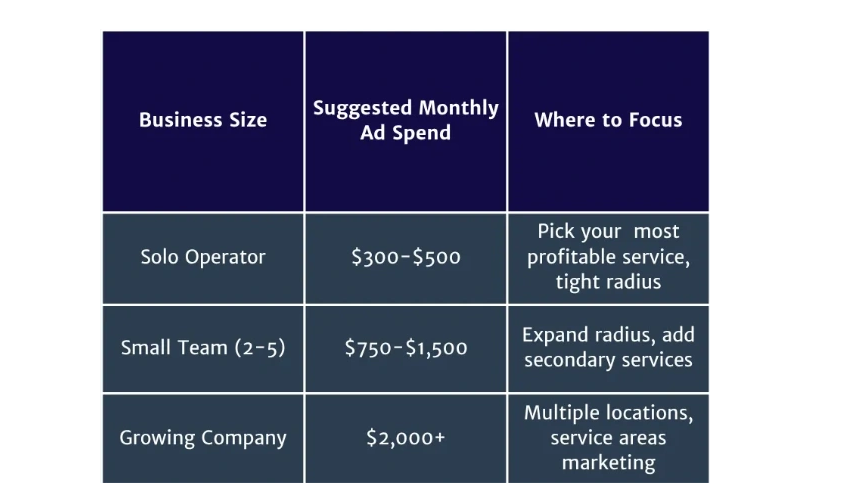
You don’t need a Fortune 500 budget. Here’s a rough guide:
Solo Operator: $300–$500
Small Team (2–5): $750–$1,500
Growing Company: $2,000+
Pro tip: Only run ads during business hours. You can cut your budget by up to 40% by avoiding ad spend when no one is available to answer calls.
Do Not Forget Retargeting
Ever felt like a business was “following” you after visiting their website? That’s retargeting (and it is not creepy when done right).
In fact, it’s one of the most effective forms of advertising:
Retargeted users are 70% more likely to convert (SharpSpring)
Retargeting increases branded searches by over 1,000% (Spiralytics)
For service providers with longer sales cycles (like remodelers, landscapers, or realtors), retargeting keeps your business top of mind, for when they are ready to act.
Final Thoughts: Don’t Just Spend—Strategize
Google Ads is not a vending machine where you drop in coins and hope for results. It is a strategic tool (when used correctly), that connects your business with people who need and/or want your products or service offerings. Similar to social media marketing strategy, starting with a big picture in mind can help with a comprehensive approach to messaging.
Too many local businesses give up after DIY attempts that fizzle. However, with the right guidance (or the right partner), you can avoid costly mistakes and build a campaign with a strong ROI.
If you’re unsure where to start or ready to optimize an existing campaign, I’d love to chat. Sometimes a 15-minute conversation can save you months of trial and error.
???? Schedule a complimentary consultation
Thanks for reading, and for investing in your organization’s visibility and growth.
Sincerely,